

Ontario’s 2026 budget, A Plan to Protect Ontario, comes at a time when many communities continue to face rising costs, housing instability, and increasing demand for social services. With a total spend of $244.2 billion, the government is emphasizing economic resilience, infrastructure investment, and affordability.
This budget invests in key areas, particularly youth supports, mental health, and economic participation. However, we see ongoing gaps in funding for the social services sector broadly, especially in addressing housing needs and ensuring that recovery is truly equitable across communities.
United Way East Ontario continues to assess how changes in provincial spending may affect local programs and supports. We are committed to advocating for investments that reflect the needs of people and communities across Lanark County, Renfrew County, Ottawa, and Prescott-Russell.

By Preeti Prabhu, Senior Director of Public Policy, Government and Stakeholder Relations, United Way East Ontario
We believe a safe, affordable, and accessible home is foundational to stability.
As outlined in United Way’s Built for Good: Delivering the Housing Ontario Needs report and plan, housing is the first step in enabling access to employment, education, food security, and overall well-being.
The 2026 provincial budget continues to prioritize increasing housing supply through investments like the Building Faster Fund ($1.2 billion) and tax measures to incentivize new rental construction. These are important steps toward addressing Ontario’s housing shortage.
This budget also includes a temporary enhancement to the Ontario HST rebate that effectively removes the eight per cent provincial portion of the HST on qualifying new homes and purpose-built rental housing, with rebates of up to $80,000.
However, as our housing report emphasizes, supply alone is not enough. Ontario’s housing challenge is not just about building more homes, but ensuring those homes are affordable and remain affordable over time—particularly for low- and moderate-income households.
As noted in our report, Ontario has already seen a significant erosion of lower-cost rental housing, reinforcing that preservation is a key supply strategy. Without targeted efforts to maintain and protect existing units, new supply alone will not keep pace with demand.
Chronic homelessness has increased and accounts for more than half of all cases of known homelessness. Youth homelessness has reached a crisis point. Each year, between 1,200 and 1,400 young people experience homelessness in Ottawa alone with many more at risk across our region. Creating long-term solutions that reduce homelessness requires a collective, community-wide response. United Way plays a vital role by convening partners across East Ontario, leveraging research, and investing in prevention-focused programs that work at a systemic level. Together, along with the city’s housing and homelessness plan and Mayor Mark Sutcliffe’s pledge to end youth homelessness by 2030, we can create lasting solutions and ensure every young person has a place to call home. United Way East Ontario has committed to raising $1 million to prevent youth homelessness over the next five years to help enable this collective goal.
We’re pleased to see the extension of the Canada-wide Early Learning and Child Care (CWELCC) agreement ($3.6 billion), as it is an important step in maintaining reduced childcare fees, which helps families better manage costs while supporting participation in the workforce. Continued investment in affordable childcare remains critical to ensuring that children have access to early learning opportunities that support long-term development.
While the province is making efforts to stabilize the post-secondary system, there remains an ongoing need to ensure that pathways to education are accessible and equitable, particularly for students facing financial barriers.
Mental health and addictions remain a key area of focus in the 2026 provincial budget, with continued investments aimed at expanding community-based services. The budget includes multi-year investments in community-based mental health and addictions services, alongside nearly $550 million to support the expansion of HART hubs.
These investments reflect a shift toward more integrated, community-based care, with an emphasis on connecting individuals to treatment, housing, and broader supports. This approach has the potential to improve coordination across systems and create more streamlined pathways to care.
At the same time, the budget signals a broader transition in service delivery, including the wind-down of provincially funded supervised consumption sites and a move toward a recovery-focused model. While this shift is intended to strengthen treatment, focused early intervention is critical to preventing substance use from progressing to addiction and reducing long-term health, social, and economic costs. Delivering upstream supports in schools and community settings, project step includes culturally appropriate services for First Nations, Métis, and Inuit youth, young mothers, and street-involved youth supports, it also represents a significant change in how services are accessed across communities. Recovery looks different for everyone. The province’s new model emphasizes abstinence as a key factor in treatment and reduces the diversity of options and entry points to recovery for people with substance use challenges, creating a gap that will require additional coordination and resources to fill. Ottawa is already seeing a spike in public drug use and overdoses, meaning front-line services, hospitals, paramedics and police services will experience added pressure in the short term. As we believe the value of community-based services lies in the ability to meet each person where they are and to tailor support to intersecting needs, we encourage funding in this space to expand rather than limit the options available to those who need help.
This budget also includes investments targeting mental health services for children and youth, including additional support for children with complex needs. It’s positive to see investments contributing to better access within specific areas of the province.
Overall, the province’s move toward more integrated mental health and addictions care presents an opportunity. Success will depend on how well new models are implemented locally, as we must ensure timely, low-barrier services remain accessible and responsive in communities as systems transition.
The 2026 Ontario budget places a strong emphasis on affordability and economic stability, anchored by an $11.9 billion package of cost-of-living measures. These include energy rebates, transportation savings, and tax relief designed to help households manage rising expenses.
These measures provide important short-term relief and reflect the government’s focus on stabilizing household finances during a period of economic uncertainty. Investments in workforce development, skills training, and employment programs further support long-term participation in the labour market.
However, the structure of these investments suggests that much of the support is broadly distributed rather than targeted. This approach can limit the impact of spending for those experiencing the greatest financial strain. Households with lower incomes or those already facing housing insecurity often require more targeted and sustained supports to achieve stability. Without this, broad affordability measures may help ease pressures but may not fully address underlying inequities.
Meanwhile, the budget includes limited new direct investments in the social sector, with community and social services funding showing only modest growth over the medium term and, in some areas, not keeping pace with inflation and rising demand.
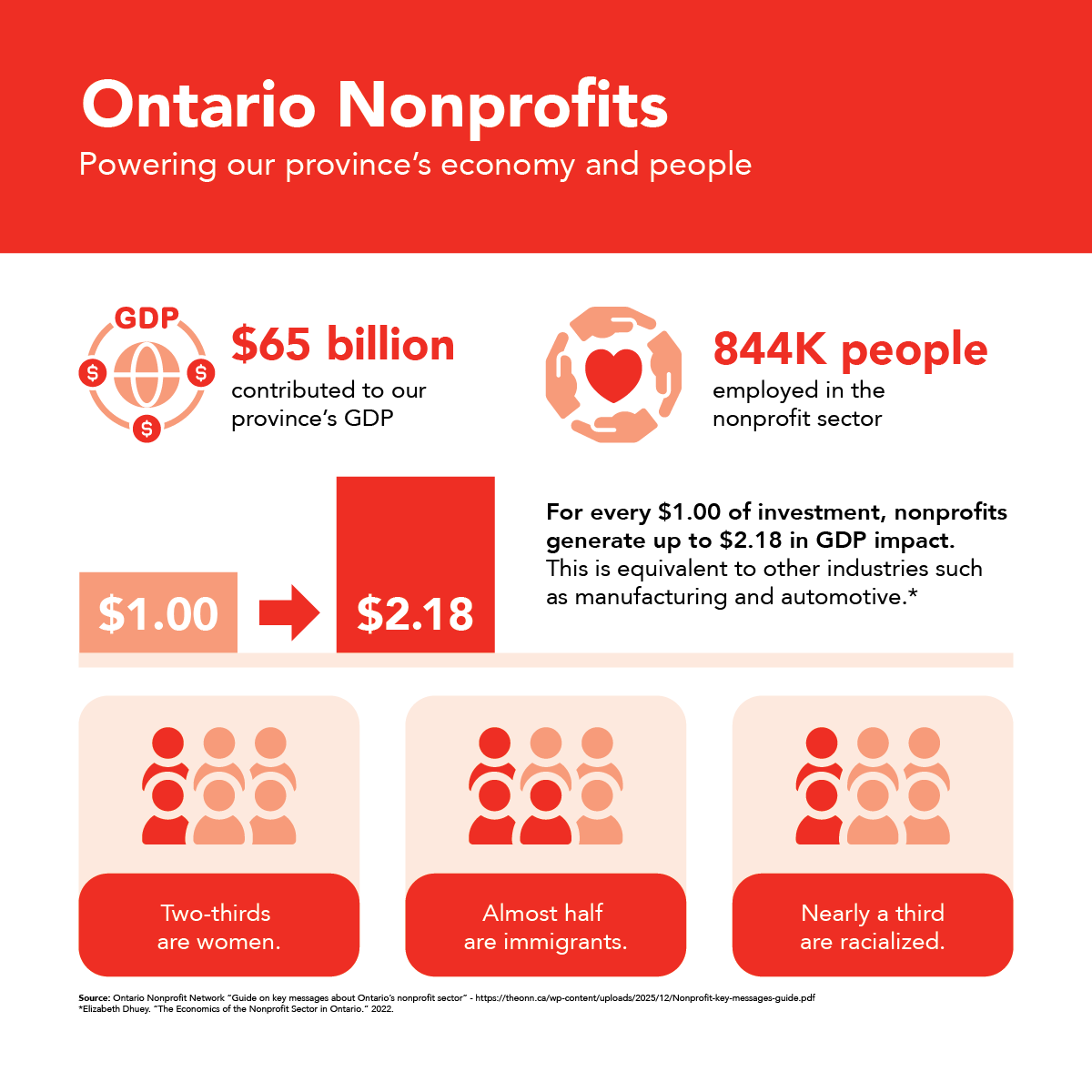
As non-profits across Ontario continue to experience increased pressure, this raises questions about the capacity of the sector to meet growing needs without more sustained and targeted funding.
United Way continues to work with the province to ensure future investments remain closely aligned with the needs of those most impacted by rising costs and economic instability.
Where we go from here
As the federal and provincial governments continue to respond to the economic impacts of U.S. tariffs, the social services sector’s role in supporting hardworking Ontarians must remain a focus. As funding for the care economy is reviewed, this budget does not fully address long‑standing underinvestment in core public services. We remain committed to working with the province to ensure communities have the supports they need.
Delivering on the priority areas outlined above will require sustained investment and strong collaboration across the province—all levels of government working together with Indigenous partners and the social services sector.
We remain committed to working in partnership with the province to ensure that communities across East Ontario have access to the supports they need to thrive. We know that with a shared focus on outcomes and who needs support most, we have an opportunity to build stronger, fairer, and more inclusive communities for everyone.